
Link Magazine !!!!!
In an era where cancer innovation is shaped by rapid advances and recurring limitations, meaningful breakthroughs seldom arise suddenly. They

Leadership Through Scientific Clarity
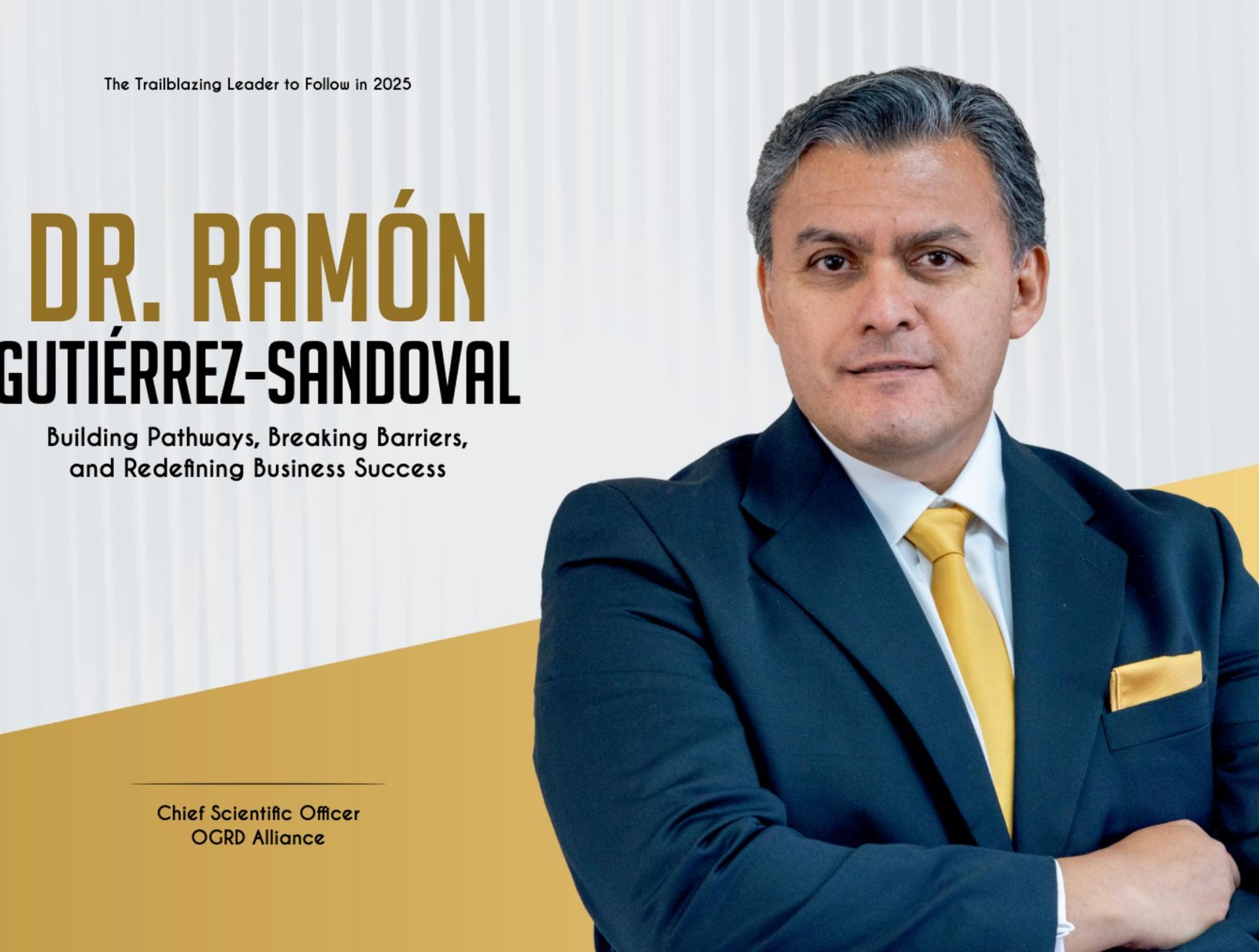
In the landscape of cancer research and immune science, progress is rarely the result of isolated discovery. More often, it is driven by leaders who are willing to interrogate prevailing wisdom, identify blind spots in established models, and persist through years of disciplined inquiry. This edition’s recognition of Most Inspiring Leader Making a Difference in 2025 is dedicated to such a figure—Dr. Ramón Gutiérrez Sandoval, Chief Scientific Officer of OGRD Alliance.
At a time when cancer innovation is largely propelled by rapid molecular advances, Dr. Gutiérrez chose to pause and ask a more foundational question—one that many had overlooked amid the race for biochemical solutions: Why does the immune system fail even when its molecular components appear intact? This inquiry, deceptively simple in form, became transformative in substance. It marked the beginning of a scientific journey that would challenge dominant assumptions and ultimately reshape how immune recovery and cancer support are understood across institutions worldwide.
For decades, immune dysfunction has been explained predominantly through molecular frameworks. Researchers have focused on cytokine imbalances, exhausted immune cell populations, and disrupted signaling pathways. While these models provided valuable insights, they often stopped short of explaining a persistent clinical paradox—patients whose laboratory markers suggested immune competence, yet whose physiological responses revealed profound vulnerability. Dr. Gutiérrez encountered this contradiction repeatedly in real-world clinical contexts, and rather than accept it as anomalous, he treated it as evidence of a deeper, unresolved problem.
As Chief Scientific Officer of OGRD Alliance, Dr. Gutiérrez has translated this philosophy into research, institutional collaboration, and practical frameworks that extend beyond theory. His leadership exemplifies the power of scientific humility—the willingness to acknowledge that prevailing models may be incomplete—and the courage to pursue alternative perspectives with rigor and clarity.
In recognizing Dr. Ramón Gutiérrez Sandoval, we honor not only his contributions to cancer and immune science, but also his mindset as a leader: one who understands that lasting impact is built through coherence, patience, and the resolve to see what others overlook. His work stands as a reminder that meaningful change in science begins not with answers, but with better questions.
Alyssa Brown
Managing Editor
.

In an era where cancer innovation is shaped by rapid advances and recurring limitations, meaningful breakthroughs seldom arise suddenly. They tend to emerge from years of disciplined questioning and a willingness to challenge assumptions. For Dr. Ramón Gutiérrez Sandoval, Chief Scientific Officer of OGRD Alliance, this journey began with a single question that altered the trajectory of his scientific work: Why does the immune system fail even when its molecular elements appear intact? The answer would lead him to develop a structural perspective now influencing how institutions worldwide view immune recovery and cancer support.
At the time, traditional explanations for immune failure were rooted almost entirely in molecular theories: dysfunctional cytokines, exhausted immune populations, or signaling mechanisms that seemed out of sync. These interpretations offered fragments of clarity, yet they consistently failed to align with what Dr. Gutiérrez witnessed in real clinical settings. Many patients displayed immune markers that looked perfectly acceptable in laboratory reports, but their immune systems behaved as though they were impaired. The issue was not the presence of molecules—it was the absence of coherence.
This disconnect between molecular sufficiency and functional collapse prompted him to reconsider the underlying assumptions of immunology. He began to explore whether something more fundamental—something structural—was being missed by conventional models.
This shift in perspective became the foundation of structural immunobiology, a discipline centered on the architectural relationships that give immune components their meaning and capability. Immune cells do not operate effectively simply because they exist; they require specific spatial relationships to interpret signals correctly. Their communication depends on proximity, orientation, and the integrity of microenvironments designed to coordinate responses. When these structures weaken or collapse, the immune system loses its ability to think clearly.
Viewed from this angle, cancer treatment is not only a biochemical problem but an architectural one. Tumors distort tissues, disrupt spatial order, and break apart the microdomains that immune cells rely on to evaluate threats. When this architecture collapses, adding more molecules is not enough. The system needs to recover its internal structure.
This insight became the conceptual backbone of the platforms now defining OGRD Alliance: PLPC-DB™, PLPC-NX™, and STIP™—three expressions of a unified scientific worldview that sees immunity as both chemistry and geometry.
PLPC-DB™: A Structural Approach to Immune Recovery
At the center of the structural paradigm is PLPC-DB™, a bioendogenous phospholipoproteic complex created to support immune function not by force, but by rebuilding the architecture through which immunity naturally operates. Traditional immunotherapies—such as CAR-T cells, checkpoint inhibitors, or engineered antibodies—work by pushing, blocking, or redirecting receptors. They rely on molecular pressure to change immune behavior. PLPC-DB™, however, follows a different logic. It is not designed to override the system; instead, it provides the physical and supramolecular scaffolding that allows immune clarity, coordination, and a renewed sense of biological order to re-emerge.
Its foundational idea is grounded in a simple but powerful principle: when immune architecture is restored, immune intelligence re-emerges. In oncology—where treatment and disease often erode structural order—this principle becomes particularly meaningful.
Chemotherapy, radiation, and chronic inflammation gradually dismantle the microenvironments immune cells depend on to function. PLPC-DB™ offers a way to replenish these disrupted structures, supporting recovery without the toxicities often associated with pharmacologic intervention. Its design reflects the supramolecular principles guiding Dr. Gutiérrez’s work: biological function emerges from structural integrity. Restore the structure, and the system reorganizes itself with remarkable consistency.
.

The concept has gained significant traction internationally. Across conferences in Asia, Europe, the Middle East, and the Americas, scientists are increasingly exploring whether immune restoration may depend less on stimulation and more on helping cells rediscover their architectural context. In many regions, the ONCOVIX™ pathway has become a translational bridge, enabling clinicians to observe how structural support behaves alongside conventional cancer treatments. Consistently described as non-pharmacodynamic, biocompatible, and aligned with emerging regulatory perspectives, PLPC-DB™ maintains a profile centered on safety, coherence, and restorative logic.
STIP™: Building the Evidence Architecture That Innovation Requires
A structural therapeutic platform demands an evidentiary system built on the same principles. This need led to the creation of STIP™ (Structural Therapeutics Integrity Platform), a framework designed to deliver clear, audit-ready documentation for interventions that operate outside classical pharmacology. As regulators increasingly adopt New Approach Methodologies (NAMs)—human-relevant, mechanism-agnostic evaluation tools—STIP™ aligns seamlessly with global regulatory evolution.
STIP™ structures evidence into four pillars: structural identity, supramolecular coherence, reproducibility, and human-aligned behavior. By transforming complexity into clarity, STIP™ enables regulators to understand therapies that do not fit standard chemical or cellular categories. In doing so, it positions OGRD Alliance not merely as a developer of products but as an architect of a new therapeutic logic grounded in structure and biological coherence.
PLPC-NX™ / Abymprosic®: Bringing Structural Coherence Into Everyday Health
If PLPC-DB™ represents the therapeutic expression of structural immunobiology, PLPC-NX™ / Abymprosic® extends that same foundation into the broader sphere of human wellness. While DB focuses on restoring immune architecture in demanding medical environments, NX™ explores how structural principles can help maintain biological balance long before the immune system begins to falter.
Over the past years, Dr. Gutiérrez’s work has gained significant attention across leading scientific and innovation communities.
He understands, perhaps more clearly than most, that cancer does not only damage tissues—it disrupts the physical structures that allow the immune system to interpret threats and coordinate responses. This architectural breakdown leaves patients vulnerable not because they lack immune cells but because those cells can no longer work together effectively.
His work addresses that vulnerability directly. Structural immunobiology is not about recreating what nature once built—it is about restoring the conditions under which nature operates successfully. For patients navigating the uncertainty of cancer treatment, that restoration can bring a renewed sense of stability—biological, emotional, and personal.
Across oncology, wellness, and evidence design, every platform within the PLPC ecosystem reflects a shared belief: biological intelligence thrives when structure is preserved. This philosophy, though elegant, is profoundly practical, addressing real-world needs in cancer care and preventive health.
Global Recognition and a Growing Influence
Over the past years, Dr. Gutiérrez’s work has gained significant attention across leading scientific and innovation communities. He has been invited to present at premier conferences including ASCO, ESMO, SITC, BioJapan, and CAP-25.
Through his Q1 peer-reviewed publications, Dr. Gutiérrez has strengthened the scientific foundations of structural immunobiology and helped define it as an emerging discipline. His contributions have been honored in multiple regions, including the Health 2.0 Visionaries Award in Dubai, the Revive ME Leadership Recognition in Abu Dhabi, and a global cover feature in Passion Vista: Men Leaders 2025.
These recognitions reflect both the novelty and maturity of his work and signal a growing readiness to explore alternatives to traditional immunotherapy.
At OGRD Alliance, each milestone represents an inflection point rather than a conclusion, reinforcing a commitment to expanding structural approaches to immune restoration.
A Legacy of Structure, Coherence, and Long-Term Purpose
When asked about legacy, Dr. Gutiérrez often returns to one idea: leadership is measured not by visibility but by the durability of the structures one creates. His work aims to outlast him, offering future scientists and clinicians frameworks to navigate the evolving landscape of cancer biology.
In a field where breakthroughs often collide with practical limits, his structural thinking provides a new orientation—suggesting that progress may arise not only from stronger interventions but from rebuilding the architectural foundations that enable the immune system to function with clarity.
As biotechnology advances toward more integrative approaches, the structural vision within the PLPC ecosystem offers a guiding principle:
Structure determines possibility.
For OGRD Alliance, for the scientific community, and for patients seeking clarity amid cancer’s uncertainty, this principle is not just a statement—it is a commitment. A commitment to a future in which cancer treatment is strengthened not only by molecular innovation, but by restoring the very architecture that allows the immune system to understand and respond to the world.